
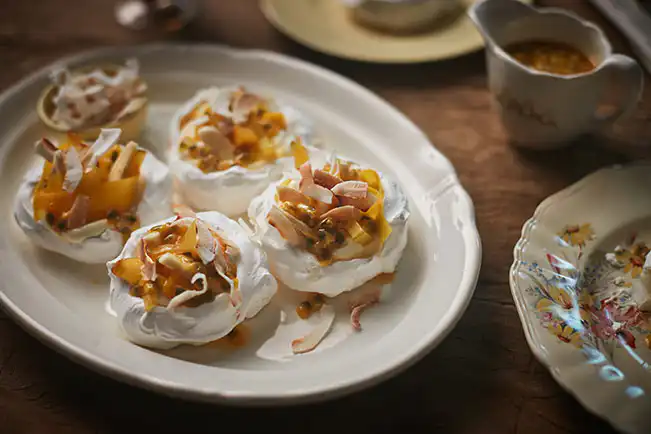

For the pavlovas
Components
- 2 egg whites
- Two-thirds of a cup of sugar
- 1½ teaspoons of cornstarch
- Half a teaspoon of apple cider vinegar
- butter to grease the baking sheet
Setup phase
- Set the oven to 160 °C (low heat). For electric ovens, heat it to 100 °C.
- Grease a large, shallow rectangular baking pan with butter. Cut a piece of parchment paper to fit the bottom of the pan using its dimensions. Press the paper onto the pan with your fingers and butter the paper as well, which will make it easier to lift the parchment off after baking.
- In the mixer bowl, beat the egg whites until they form soft peaks: begin at low speed; as they start to foam, raise the speed to medium. When the mixture turns into a thick, white foam after approximately 5 minutes, add the vinegar and continue beating until stiff peaks form.
- Maintain the mixer on medium speed and slowly add the sugar, one spoonful at a time, beating for approximately 30 seconds after each addition—this helps fully incorporate the sugar, resulting in a very smooth meringue. If necessary, pause to scrape down the sides of the mixer bowl with a spatula.
- Once all the sugar has been added, continue beating for a few more minutes until the meringue is firm, smooth, and glossy. To test, scoop a small amount with a spoon and gently rub it between your fingertips to ensure there are no remaining sugar granules. Then, add the cornstarch and beat just enough to combine.
- Using a large serving spoon, place the meringue into the baking pan, shaping it into six tall mounds. With the tip of a tablespoon, create a hollow in the center of each mound, resembling a small bowl, to hold the filling after the pavlova is baked. There’s no need to shape them perfectly; the more rustic they look, the more attractive they become.
- Place in the preheated oven to bake for approximately 35 minutes, keeping the door slightly ajar by placing a wooden spoon between the door and the oven. If using an electric oven preheated to 100 °C, there is no need to keep the door ajar. Be careful with the baking time: the pavlovas will turn opaque and begin to dry on the surface, but they should not brown.
- Switch off the heat and leave the baking pan inside the oven with the door open for 1 hour to allow gentle baking without damage. For an electric oven, keep the door closed after turning the oven off.
- Once fully dry and cooled, gently take out the paper straws without breaking them and arrange the pavlovas into a cross. Alternatively, you can bake the pavlovas a day in advance.
You can keep the pavlovas in a tightly covered baking dish wrapped with plastic wrap at room temperature for up to three days.
FOR THE FILLING AND ASSEMBLY
Components
- 1 passion fruit (approximately 1/2 cup of pulp)
- A petite face
- One ripe yet still crisp sleeve
- One small silver banana
- 1 cup (tea) of roasted dried coconut strips
- Half a cup of ice cream (tea flavor)
- 1½ tablespoons of sugar
Setup mode
- Remove the peel from the sleeve. Using a vegetable peeler, slice half of the sleeve into strips. Discard the core and chop the remaining half into 1 cm cubes. Rinse, dry, and slice the starfruit lengthwise down the middle, then cut each half into thin slices to create half-star shapes. Peel the banana and cut it into 0.5 cm thick half-moon slices.
- In a medium bowl, combine the cream and 1 tablespoon of sugar, then whisk vigorously with a wire whisk until it becomes thick. Set aside.
- Slice off the top of the passion fruit and use a spoon to scoop the pulp into a bowl – stir thoroughly to loosen the seeds. Incorporate half of the passion fruit pulp into the whipped cream and fold gently. To the remaining pulp, add half a tablespoon of sugar and stir well to create a syrup.
- To assemble, use a spoon to fill the pavlova cavities with the passion fruit whipped cream; garnish with fruit and drizzle with passion fruit syrup. Serve immediately.
You can store the assembled pavlovas in the refrigerator for up to 30 minutes prior to serving.

